
Most businesses are ready for fractional CFO support when revenue runs roughly $2 to $25 million, when growth has outpaced what their bookkeeper or controller can handle, or when a major decision (a capital raise, an acquisition, a leadership change) requires forecasting and scenario modeling they can’t do internally. A fractional CFO gives you senior financial strategy without the cost of a full-time executive. The clearest signal isn’t a revenue number, though. It’s the moment financial questions start outpacing your ability to answer them.
Detweiler Hershey delivers this support through the CFO/FP&A tier of its RAMP Advisory Services, working with growth-oriented businesses across the Delaware Valley and nationally. The question we hear most often isn’t whether a fractional CFO would help. It’s how to know the timing is right.
In our experience at Detweiler Hershey, the owners who benefit most from fractional CFO support aren’t the ones already in pain, dealing with a cash crunch, a deal they can’t model, or a board asking questions they can’t answer. They’re the ones with a real decision coming. If you’re making a decision this year that the numbers need to inform, that’s when CFO support earns its keep. That was the case for Genzeon, a global technology solutions provider, whose leadership recognized that traditional, reactive accounting wasn’t enough for a company in growth mode and brought in Detweiler Hershey for a forward-looking financial partnership. Their full story is in Achieving Financial Clarity and Scalability with Advisory Services.
What Does a Fractional CFO Actually Do?
A fractional CFO provides the strategic financial functions of a full-time chief financial officer on a part-time or retainer basis. At Detweiler Hershey, that work, delivered through the RAMP CFO/FP&A tier, may include budgeting and forecasting, cash flow planning, scenario modeling, profitability analysis, and strategic support. (For a closer look at two of those tools, see Budgets vs. Forecasts: Why Growing Companies Need Both.) The work is forward-looking. It’s about where the business is going, not just recording where it has been.
This is different from bookkeeping or even controller-level work. Bookkeeping records transactions. A controller keeps the financial operation running and accurate. A fractional CFO uses that foundation to answer strategic questions: Can we afford this hire? What happens to cash if growth slows for two quarters? Is this product line actually profitable once we load in overhead? Should we raise capital now or wait?
What Are the Signs You’ve Outgrown Your Current Finance Setup?
The signals usually show up well before a crisis. A few of the most common:
You can’t answer basic forward-looking questions on demand, like how many months of cash runway you have, what your gross margin trend looks like year over year, or what a 20% revenue swing would do to your bottom line.
Your monthly close is slow or unreliable, so by the time you see the numbers, they’re too old to act on.
You’re making significant decisions about hiring, expansion, pricing, or financing on instinct, because no one is modeling the financial outcomes first.
A bank, investor, or potential acquirer has asked for projections or financial analysis you couldn’t readily produce.
You, the owner, are spending time on financial questions that pull you away from running and growing the business.
Any one of these is worth noting. Two or more at once usually means the finance function has fallen behind the business.
How Is a Fractional CFO Different From a Controller?
A controller provides ongoing accounting oversight and financial process support: improving workflows, monitoring cash flow, and creating more structure around the finance function. In Detweiler Hershey’s RAMP framework, closing the books and preparing financial reporting sit one tier below, in Reporting. The Controller tier is about managing and strengthening the process itself. A fractional CFO works one level above the controller, using that foundation to guide decisions about what should happen next.
Many growing businesses need the controller function before they need a CFO, which is why Detweiler Hershey separates them into distinct RAMP tiers. A company with reliable books and reporting but no forecasting or strategic input is typically ready to add CFO/FP&A support on top of its existing setup, rather than replacing anything.
When Is It Too Early for a Fractional CFO?
It’s usually too early if your books aren’t yet clean and current. A fractional CFO builds forecasts and analysis on top of accurate financial data, and if the underlying records are unreliable, the strategic work sits on a weak foundation. Businesses in that position are better served by starting with bookkeeping and reporting (RAMP Foundation and Reporting) and adding CFO support once the data can be trusted.
It can also be too early if there are no significant decisions on the horizon and the business is stable and predictable. CFO support pays off most when there’s something to plan for. If nothing is changing, the controller level may be enough for now.
How Does Detweiler Hershey’s RAMP CFO/FP&A Tier Work?
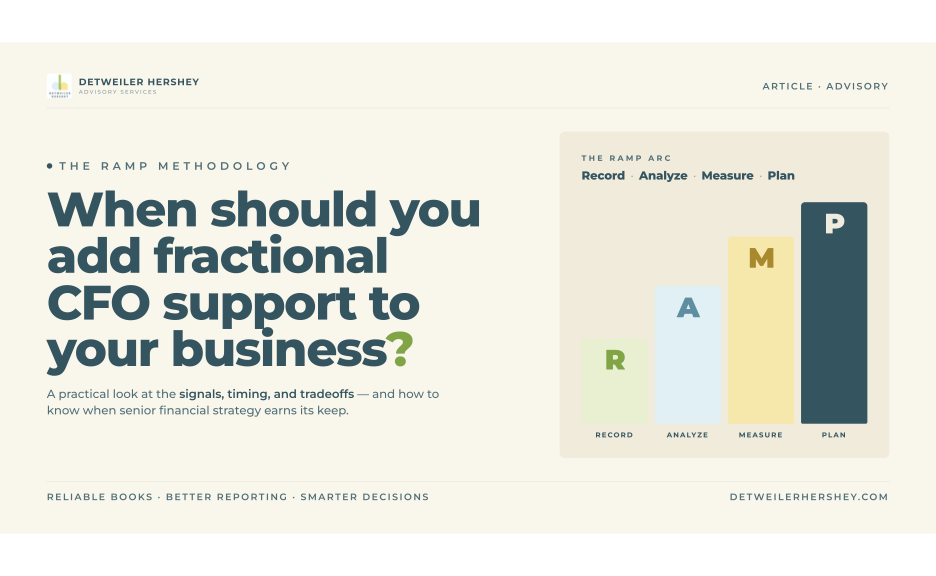
The CFO/FP&A tier provides fractional CFO services scoped to where your business actually is. It sits at the top of the RAMP framework, building on the bookkeeping, reporting, and controller-level work in the tiers below it. You can see the full scope on our CFO, FP&A, & Controller Services page. For a business that already has clean books and reliable reporting, it can be added directly. For a business still building that foundation, it becomes the destination as the lower tiers do their work.
The result is senior financial leadership (forecasting, modeling, and strategic guidance) without the salary, equity, and overhead of a full-time CFO hire. To find out whether your business is ready, the next step is a RAMP assessment with the Detweiler Hershey team.
Frequently Asked Questions
At what revenue should I hire a fractional CFO? There’s no hard cutoff, but most businesses find fractional CFO support valuable somewhere in the $2 to $25 million revenue range. More important than the number is whether you’re facing decisions around growth, financing, or acquisitions that require financial forecasting and modeling you can’t do internally. A stable business at $10M might not need one, while a fast-scaling business at $3M facing a capital raise often does.
How is a fractional CFO different from hiring a full-time CFO? A fractional CFO provides the same strategic functions (forecasting, budgeting, scenario modeling, strategic guidance) on a part-time or retainer basis, at a fraction of the cost of a full-time executive. For most businesses under roughly $25M in revenue, the workload doesn’t justify a full-time CFO salary, equity, and benefits package, which makes the fractional model a better economic fit.
Can I add a fractional CFO without replacing my bookkeeper or controller? Yes, and that’s usually how it works. A fractional CFO operates on top of your existing bookkeeping and controller functions, using accurate financial data to guide strategy. At Detweiler Hershey, the CFO/FP&A tier is designed to layer onto the foundation provided by the lower RAMP tiers rather than replace it.
What if my books aren’t in good shape yet? Is it still worth getting CFO help? Strategic financial work depends on reliable data, so if your books are disorganized or behind, the more effective first step is usually cleanup and ongoing bookkeeping. Detweiler Hershey handles this through the lower RAMP tiers, then adds CFO/FP&A support once the financial data can be trusted. Building forecasts on bad data wastes the value of CFO work.
How quickly will I see value from a fractional CFO? It depends on what triggered the need. If you’re facing a specific decision like a raise, an acquisition, or a major hire, a fractional CFO can deliver useful modeling within the first engagement. The compounding value comes over time, as forecasting and regular financial guidance change how decisions get made across the business.
One thought on “When Should You Add Fractional CFO Support to Your Business?”
Comments are closed.