
The month-end close is the process of finalizing your accounting records for a completed month so the resulting financial statements are accurate and can be relied on. It involves reconciling accounts, recording adjusting entries, reviewing revenue and expenses for completeness, and producing statements on a set schedule. For most small and midsize businesses, a healthy close finishes within ten business days of month end. At Detweiler Hershey, the close is the operational core of our RAMP Foundation and Controller tiers, because everything a business does with its numbers depends on the month actually being finished.
Why does the month-end close matter?
Because an unfinished month is an unusable month.
Owners often treat the close as an accounting formality, something the bookkeeper does that produces a report nobody reads. That framing gets it backwards. The close is what converts raw transaction activity into information you can make a decision with. Without it, you have a bank balance and a feeling.
Three things break when the close is loose:
Comparability breaks. If January’s expenses were recorded on a cash basis because nobody accrued the December invoices, and February’s were accrued properly, the two months are not comparable. Any trend you read off them is noise.
Timeliness breaks. Numbers that arrive on the twenty-eighth of the following month describe a period you can no longer influence. By then you are reacting to history.
Trust breaks. This is the one that lingers. Once an owner has been burned by a report that turned out to be wrong, they stop using reports. I have met business owners running eight-figure companies almost entirely on intuition, not because they are anti-analytical, but because the numbers embarrassed them once and they never went back.
What are the steps in a month-end close?
The specifics vary by business, but the sequence is fairly universal. Here is the order we work in.
1. Cut off the period
Establish the closing date and stop posting to the prior month. Sounds obvious. In practice, the most common cause of a report changing after it was distributed is that someone kept posting into a period everyone thought was finished. Lock the period once it is closed.
2. Reconcile cash accounts
Every bank account, every credit card, every merchant processing account. Reconciled means each item ties to the statement, not that the balances happen to be close. Unreconciled cash accounts invalidate everything downstream.
3. Review accounts receivable
Confirm all revenue for the period has been invoiced, review the aging, and address anything genuinely uncollectible. This is also where you catch invoices that were created and never sent, which is a more common leak than most owners believe.
4. Review accounts payable and accruals
Capture expenses incurred in the period even if the bill has not arrived yet. Utilities, professional fees, and contractor work are the usual offenders. This is what makes months comparable to each other, and it is the step most often skipped in a rushed close.
5. Record recurring journal entries
Depreciation, amortization, prepaid expense releases, and any allocations you run. These should be scheduled and repeatable, not reinvented each month.
6. Reconcile the rest of the balance sheet
Inventory, fixed assets, loans and lines of credit, payroll liabilities, and sales tax payable. Balance sheet accounts are where errors go to hide, because a wrong number sitting in a liability account does not draw attention the way a wrong number in revenue does.
7. Review the income statement for reasonableness
Compare against the prior month, the same month last year, and budget. You are looking for anything that moved without a reason you can explain. A margin that jumped three points is either good news you should understand or a coding error you should fix.
8. Produce and distribute the statements
Balance sheet, income statement, cash flow statement, and whatever supporting schedules your business runs on. Same format every month, delivered on a known date. What you do with those statements is a separate discipline, and we covered it in more depth in our piece on financial reporting best practices for scaling companies.
How long should a month-end close take?
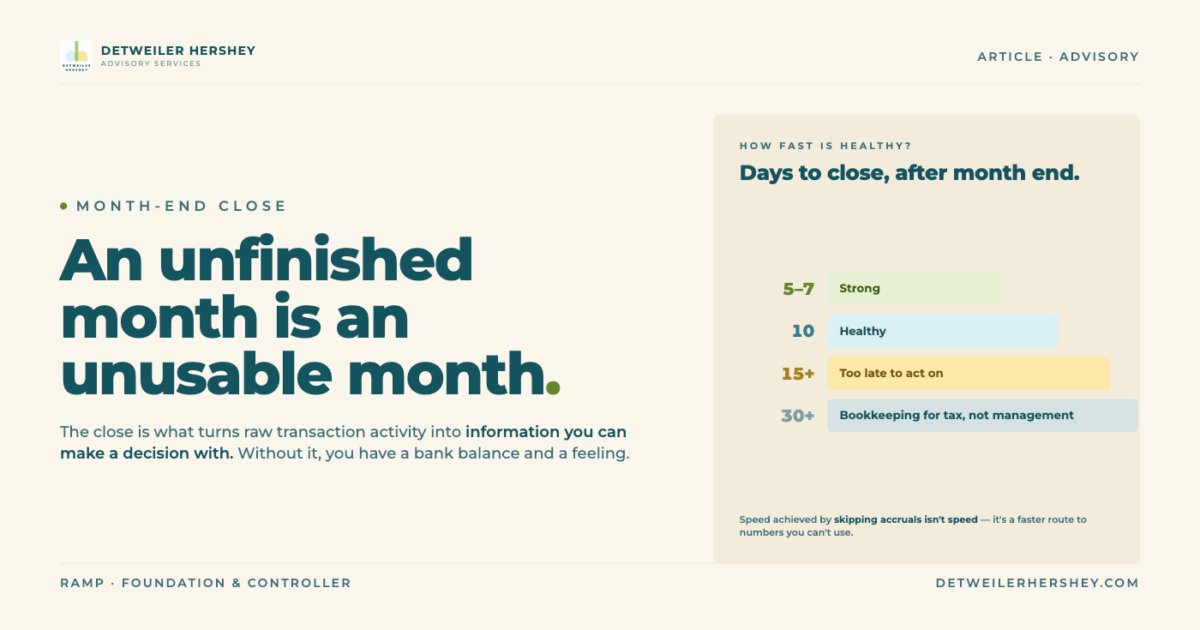
For most small and midsize businesses, a close that lands within ten business days of month end is healthy. Five to seven days is strong. Anything past fifteen days is producing information too late to act on, and past thirty days you are effectively doing bookkeeping for tax purposes rather than management purposes.
Two honest caveats. First, businesses with inventory, percentage of completion revenue, or multiple entities legitimately take longer, and comparing yourself to a single-entity service business is not useful. Second, speed achieved by skipping accruals is not speed. It is a faster route to numbers you cannot use.
If your close is slow, the bottleneck is almost never the accounting work. It is waiting on documents, waiting on someone to code the credit card activity, or waiting on an approval. Those are process problems with process fixes.
What makes a close go wrong?
Patterns I see repeatedly:
No defined checklist. The close lives in one person’s head. When that person is out, or leaves, the process leaves with them.
No cutoff discipline. Transactions posted into closed periods, which quietly changes reports that were already distributed.
Reconciliations treated as optional when things are busy. They are the first thing dropped under time pressure and the most expensive thing to skip.
Accruals abandoned for speed. The month closes faster and means less.
Nobody reviewing the output. Someone other than the person who prepared the statements should read them and ask why things moved. Preparation and review are different functions, and collapsing them into one person removes the only control on the process.
That last one is a big part of what separates bookkeeping from controller-level work. If the distinction is fuzzy, we broke it down in fractional CFO vs. controller vs. bookkeeper.
How does Detweiler Hershey handle the month-end close?
We run the close as a documented, repeatable process rather than a monthly improvisation, and we treat it as the hinge between accurate records and useful advice.
Inside our RAMP framework, Foundation covers the monthly bookkeeping and reconciliation work that makes a close possible. The Controller tier adds the review layer: independent examination of the statements, variance analysis against prior periods and budget, and a scheduled conversation about what the month actually says. CFO and FP&A work sits above that and uses the closed month as an input to forecasting and planning.
The reason we structure it that way is that clients arrive at different points on that path. Some need the close built from nothing because records are behind, which starts with cleanup. Others already have a competent bookkeeper and need the review function their bookkeeper cannot provide for themselves. The RAMP assessment exists to figure out which one you are.
Our client Mike Pieteg at Genzeon described the value in terms of accountability rather than accounting, and I think that is the right word. A close that happens on a schedule creates a standing appointment with reality. You can read the full Genzeon story for how that played out for a company scaling globally.
We have been doing this work from Souderton since 1946, for businesses across Lansdale, Harleysville, Telford, Hatfield, Quakertown, and well beyond the Indian Valley.
Frequently asked questions
What is the difference between a month-end close and a year-end close?
A month-end close finalizes one month so you can manage the business. A year-end close finalizes the fiscal year for tax filing, financial statement issuance, and any audit or review requirements, and it includes work that only happens annually, such as final depreciation schedules, inventory counts, and equity adjustments. The practical relationship is that twelve clean monthly closes make year end straightforward, while twelve loose ones turn year end into a reconstruction project.
Do small businesses really need a formal month-end close?
Yes, though the scope should match the business. A five-person service company does not need a twenty-step checklist. It does need reconciled cash accounts, captured expenses, and statements produced on a schedule. The formality that matters is consistency, not complexity. Doing four steps the same way every month beats doing twelve steps sporadically.
Can we close the books faster without hurting accuracy?
Usually, yes, and the gains almost always come from process rather than accounting. Automate bank and credit card feeds, set a hard internal deadline for receipt and expense submission, standardize recurring journal entries, and use a materiality threshold so you are not chasing forty dollar accruals. What does not work is dropping reconciliations or accruals, which trades accuracy for a calendar date.
Who should be responsible for the month-end close in a small business?
Whoever does the transactional work should prepare the close, and someone else should review it. In a small business that reviewer is often external, because there is nobody internally with both the expertise and the independence. That review function is precisely what controller-level support provides, and it is the most common reason clients move from Foundation to Controller with us.
What should I be looking at first when I get my monthly statements?
Start with cash, then margin, then the balance sheet trend lines. Specifically: what happened to your cash position and why, whether gross margin moved and whether you can explain the movement, and whether receivables or payables are aging in a direction you did not intend. Everything else can wait for the second read.
One thought on “Month-End Close Process: A Guide for Business Owners”
Comments are closed.