
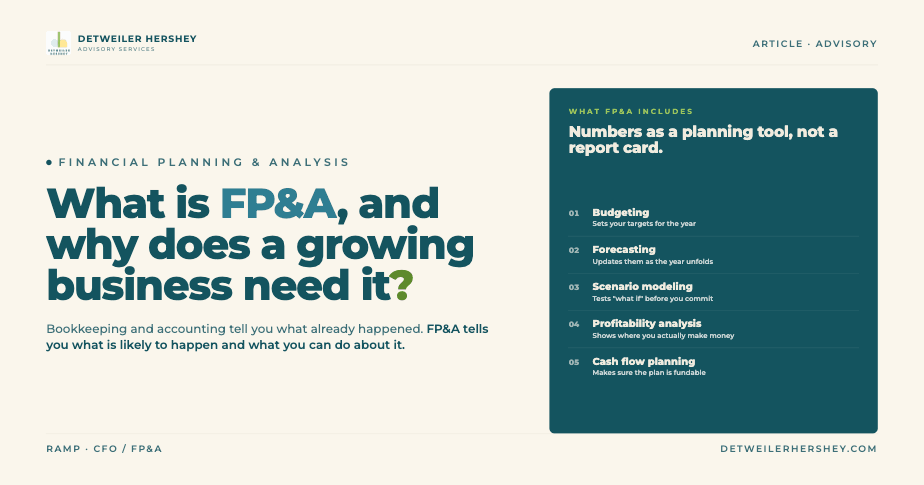
FP&A (financial planning and analysis) is the work of using your financial data to plan what comes next. It includes building budgets and forecasts, modeling scenarios, and analyzing profitability so you can make decisions before the results arrive. Bookkeeping and accounting tell you what already happened. FP&A tells you what is likely to happen and what you can do about it.
At Detweiler Hershey, FP&A is delivered through the CFO/FP&A tier of our RAMP Advisory Services. This is the point where your numbers stop being a report card and start being a planning tool.
I’m Michael Mazza, a partner at Detweiler Hershey in Souderton. Most of the business owners I work with across the Indian Valley don’t come to me asking for FP&A. They come with a question they can’t answer yet. Can we afford this hire? What happens if our biggest customer slows down? How much room do we have before margins get squeezed? FP&A is the discipline that answers those questions with numbers instead of instinct.
What does FP&A actually include?
FP&A covers the forward-looking side of the finance function. In our CFO/FP&A tier, that may include budgeting and forecasting, cash flow planning, scenario modeling, profitability analysis, and strategic support. Each piece answers a different question:
- Budgeting sets your targets for the year: what you expect to earn, spend, and invest.
- Forecasting updates those expectations as the year unfolds, so you’re steering by current information instead of January’s assumptions.
- Scenario modeling tests “what if” questions before you commit: a price change, a new hire, a lost customer, a supply constraint.
- Profitability analysis shows where you actually make money, by product, customer, or service line, and where you don’t.
- Cash flow planning makes sure the plan is fundable, because a profitable plan can still run out of cash.
Budgets and forecasts get confused more than any other pair here. We covered the difference in Budgets vs. Forecasts: Why Growing Companies Need Both.
How is FP&A different from bookkeeping and accounting?
Bookkeeping records transactions. Accounting and controller work make sure those records are accurate, closed on time, and turned into reliable financial statements. FP&A takes those statements and uses them to look forward.
In RAMP terms, the sequence is Record & Reconcile, Analyze, Measure, Plan. FP&A lives mostly in the Plan stage, and it only works when the stages underneath it are solid.
My view is simple: a forecast built on books that haven’t been reconciled is a guess with formatting. [MICHAEL TO APPROVE] That’s why I’m careful about order. If a business needs cleanup or a dependable month-end close first, that’s where we start. Fractional CFO vs. Controller vs. Bookkeeper lays out how each role builds on the one before it.
What does scenario modeling look like in a real business?
[MICHAEL TO APPROVE: client anecdote, non-identifying]
One of our clients depends on an outside supplier for production, and that supplier was heading toward its production capacity. Once it got there, our client would face one of two outcomes. They could cap their own growth at what the supplier could produce, or they could take on new costs to run additional lines. Either path changes margin.
We didn’t wait for the capacity ceiling to show up in the financial statements. We started planning and forecasting for it ahead of time. We modeled what margins look like if growth has to pause at the supplier’s limit, and what they look like if the business absorbs the cost of added capacity.
The value wasn’t a single number. It was that the owner could see both paths side by side, understand what each would do to margin, and make the call on their own terms instead of reacting after the squeeze had started.
That’s scenario modeling in practice. It isn’t an abstract spreadsheet exercise. It turns a problem you would otherwise discover the hard way into a decision you get to plan for.
Why does a longer-range forecast matter for a small business?
Many small businesses plan one month or one quarter at a time. That works until a decision comes along with a longer tail: a piece of equipment, a new location, a key hire, a financing conversation. Those decisions play out over years, and they deserve a view that reaches that far.
Aunt Wendy’s Kiffles, a bakery in Bath, PA, shows how forecasting fits inside a complete finance function. Detweiler Hershey handles the full back office for the business. That covers bookkeeping, monthly financial statements that we review with the owner, accounts receivable management, tax planning, and two-year forecasts.
The forecast doesn’t stand alone. It rests on the monthly books, gets checked against actual results in each monthly review, and feeds the tax planning conversation. When all of those pieces sit with one team, the forecast stays connected to what’s happening in the business. It doesn’t become a once-a-year document nobody opens.
A two-year horizon is long enough to see the effect of the decisions that matter most:
- Timing major purchases so they don’t collide with slow cash months
- Knowing when growth will require new people, and what that does to margin
- Walking into a lender conversation with projections already built
- Planning owner compensation and taxes with the year ahead in view, not the year behind
You can read the full story in Growing Together: A Long-Standing Partnership with Detweiler Hershey.
When is a business ready for FP&A?
A business is usually ready for FP&A when its decisions have outgrown its information. The common signals:
- You’re making hiring, equipment, pricing, or expansion decisions with no model behind them.
- Sales are strong but cash keeps getting tighter. Our guide to cash flow planning for growing businesses covers why this happens.
- Your margins are moving and you can’t explain why.
- An outside factor, like a supplier, a major customer, or a lender, could change your economics and you haven’t quantified it.
- A bank, investor, or partner is asking for projections.
- Your books close accurately every month, so there’s a reliable base to build on.
That last point is the prerequisite. For revenue range and growth signals, see When Should You Add Fractional CFO Support to Your Business?
Do you need a full-time FP&A team to get this?
No. Most small and mid-sized businesses can’t justify a full-time FP&A analyst, let alone a full-time CFO to direct one. They still face the same decisions a larger company does.
The CFO/FP&A tier gives you that function scoped to your business. You get the forecasting, scenario modeling, and profitability analysis a full-time finance leader would provide, at the level of involvement your decisions actually require.
Because RAMP sits inside a full-service firm, the plan also connects to everything else. The same team that keeps your books current and handles your tax planning builds the forecast. Assumptions don’t get lost between separate providers. You can see the full scope on our CFO, FP&A, & Controller Services page.
What should you bring to a first FP&A conversation?
You don’t need a finished budget or a polished model. The most useful starting points are:
- Your last 12 to 24 months of financial statements
- Any budget or targets you’re working from, even informal ones
- The one decision that’s been on your mind the longest
- Any constraint you already see coming, whether it’s a supplier, a customer concentration, or a lease renewal
That last item is usually where the first scenario comes from. If you want to talk through where FP&A fits for your business, start a conversation with the Detweiler Hershey advisory team.
Frequently Asked Questions
What does FP&A stand for? FP&A stands for financial planning and analysis. It’s the part of the finance function that looks forward: budgeting, forecasting, scenario modeling, and profitability analysis. Accounting records and reports what happened. FP&A uses those results to plan what happens next.
Is FP&A only for large companies? No. Large companies have dedicated FP&A departments, but the questions FP&A answers apply to any business making decisions about hiring, pricing, equipment, or growth. Small and mid-sized businesses typically get FP&A through a fractional or outsourced arrangement rather than a full-time hire.
What’s the difference between FP&A and a fractional CFO? FP&A is the planning and analysis work itself. A fractional CFO leads that work and adds broader strategic guidance on things like financing, growth strategy, and major decisions. At Detweiler Hershey, the CFO/FP&A tier covers both, so you get the planning engine and the senior judgment that directs it.
How often should a small business update its forecast? Monthly is the most useful rhythm for most businesses. After each month closes, compare actual results to the forecast, understand the differences, and update the months ahead. A forecast that only gets updated once a year stops being useful within a quarter.
Can you build a forecast if my books aren’t clean? Not a reliable one. A forecast is only as good as the historical data underneath it. If your records need work, the right starting point is the Cleanup or Foundation tier of RAMP. Forecasting then builds on numbers you can trust.