
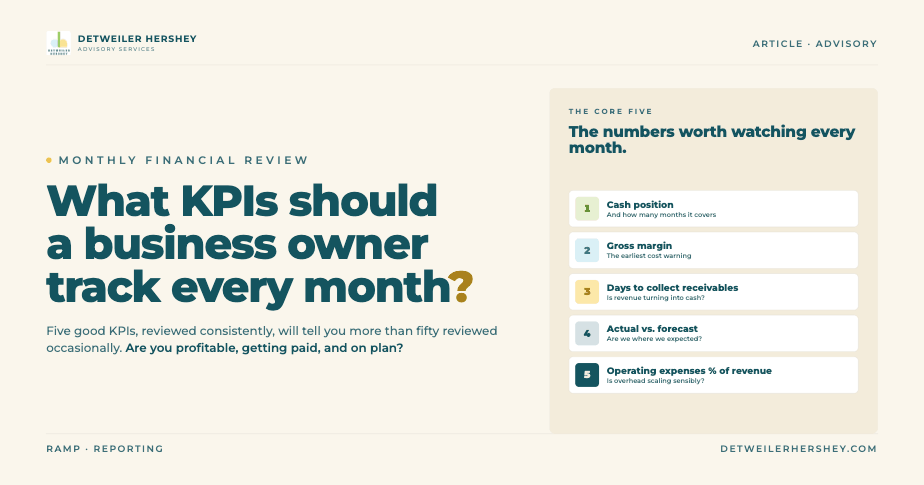
Most business owners should track five KPIs every month:
- Cash position
- Gross margin
- How long it takes to collect receivables
- Actual results against forecast
- Operating expenses as a share of revenue
Together, they tell you whether you’re profitable, whether you’re getting paid, and whether the business is on the path you planned. At Detweiler Hershey, these measures are the backbone of the monthly financial review in our RAMP Reporting tier. They’re the “Measure” in RAMP.
I’m Michael Mazza, a partner at Detweiler Hershey. When I sit down with a business owner in Souderton, Harleysville, or Lansdale for a monthly review, I’m not walking them through every line of the financial statements. I’m pointing at a handful of numbers that tell us whether anything needs attention. Five good KPIs, reviewed consistently, will tell you more than fifty reviewed occasionally.
What makes a KPI worth tracking monthly?
A KPI earns a spot on your monthly review if it meets four tests:
- It connects to a decision. If the number moved, you would do something differently.
- It comes from your close. It can be pulled reliably from your monthly books, not estimated.
- It’s comparable. It’s calculated the same way every month, so trends are real.
- It’s one of a few. Too many KPIs and none of them get attention.
Consistency matters as much as accuracy, which we covered in Financial Reporting Best Practices for Scaling Companies.
How much cash do you actually have, and how long will it last?
Cash position is the first number I look at, because it’s the one that can end a business fastest. Track your ending cash balance each month alongside how many months of operating expenses it would cover.
The trend matters more than the balance. Cash that declines three months in a row while sales are rising is a signal, not a coincidence. Growth consumes cash, and our guide to cash flow planning for growing businesses explains how to stay ahead of it.
Is your gross margin holding?
Gross margin is revenue minus the direct cost of delivering your product or service, shown as a percentage of revenue. It’s usually the earliest warning that something in your cost structure has changed: supplier pricing, labor costs, waste, or discounting.
A two-point drop in gross margin can erase a year of revenue growth. Watching it monthly lets you catch the change while it’s still small.
Margin pressure doesn’t always come from inside the business. We recently helped a client plan for a supplier nearing its production capacity, which would either cap their growth or add new costs. We covered how we modeled it in What Is FP&A, and Why Does a Growing Business Need It? [LINK: confirm after Oct 14 publish]
How long does it take you to get paid?
Accounts receivable tells you how much money customers owe you. How long it takes to collect tells you whether your revenue is turning into cash. Track total receivables, the share that’s past due, and your average days to collect.
Compare that average against your payment terms. If your terms are 30 days and customers are paying in 50, you’re financing your customers’ businesses with your own cash.
There’s a quieter version of this problem: money you never billed at all. In a recent monthly review, we showed a client invoices that had never been sent to customers. The same review caught items a vendor had been billing them for twice. A monthly check of billing against work delivered is how those get caught. [MICHAEL TO APPROVE: client anecdote, also used in the Bad Bookkeeping draft]
Accounts receivable management is part of the ongoing work Detweiler Hershey does for Aunt Wendy’s Kiffles, a bakery in Bath, PA that sells through wholesale and retail channels with different payment terms. It’s reviewed alongside the monthly financials instead of being handled separately. Collections are part of the financial picture, not an administrative afterthought. You can read more in Growing Together: A Long-Standing Partnership with Detweiler Hershey.
Are you ahead of or behind your forecast?
Comparing actual results to your forecast each month is called variance analysis. It answers the question every owner is really asking: are we where we expected to be?
The goal isn’t to explain every dollar. It’s to find the two or three differences that matter and understand why they happened. Was revenue behind because of timing or because demand softened? Were expenses over because of a one-time cost or a new run rate?
This KPI requires a forecast to compare against. If you don’t have one, Budgets vs. Forecasts: Why Growing Companies Need Both is a good place to start.
Are operating expenses growing faster than revenue?
Operating expenses as a percentage of revenue shows whether your overhead is scaling sensibly. Rent, salaries outside of production, software, insurance, and administrative costs all belong here.
In a healthy growing business, this percentage holds steady or declines as revenue rises. If it’s climbing, the business is adding cost faster than it’s adding sales. That’s often a sign of hiring ahead of demand or subscriptions and services nobody has reviewed in a while.
Should you track industry-specific KPIs too?
Yes, but only one to three of them, added on top of the core five. The right ones depend on how your business makes money:
- A construction or trades business might track backlog and job-level margin.
- A professional services firm might track billable utilization.
- A product business might track inventory turnover.
Pick the metrics that would change a decision in your business, and leave the rest out of the monthly review.
How should you review KPIs each month?
The review matters as much as the numbers. The rhythm that works:
- Close the books.
- Produce the financial statements and KPIs in the same format as last month.
- Look for the numbers that moved.
- Ask why.
- Decide what, if anything, to do about it.
For Aunt Wendy’s, that means monthly financial statements reviewed with the owner, not just delivered. The conversation is where the KPIs turn into decisions.
The review should happen on a consistent date, soon enough after month-end that the information is still useful. Our Month-End Close Process guide walks through how to get there.
Why do KPIs depend on a reliable month-end close?
Every KPI in this post is calculated from your closed books. If the close is late, the KPIs are stale. If the close is inconsistent, the trends are fiction.
I tell clients that a KPI dashboard sitting on top of unreconciled books is worse than no dashboard, because it gives you confidence you haven’t earned. [MICHAEL TO APPROVE] The close comes first. Measurement comes second. That’s the order RAMP is built on.
How does Detweiler Hershey help business owners track KPIs?
KPI tracking is built into RAMP Reporting. At that tier, Detweiler Hershey helps close the books, prepare financial reporting, and provide periodic insight into performance. That turns accurate records into a clear read on how the business is actually doing.
Businesses that need more structure around the finance function move into RAMP Controller, which adds ongoing oversight and process support. You can read more in Outsourced Controller Services: When Outsourced Bookkeeping Isn’t Enough.
When the KPIs start raising forward-looking questions, like “what happens if” or “can we afford to,” that’s the CFO/FP&A tier. We serve businesses across the Indian Valley and growth-oriented companies nationally. The full structure is on our CFO, FP&A, & Controller Services page.
Where should you start?
Pull your last six months of financial statements and calculate the five core KPIs for each month. You’re not looking for perfect numbers. You’re looking for direction: which of the five is moving, and which way.
If the numbers are hard to pull, or you don’t trust them once you have them, that tells you something too. Talk with the Detweiler Hershey team about which RAMP tier fits where your business is today.
Frequently Asked Questions
How many KPIs should a small business track? Most small businesses do best with five core financial KPIs plus one to three specific to their industry. More than that and the monthly review turns into a data dump instead of a decision-making tool. You can always track additional metrics in the background without putting them on the monthly review.
What’s the difference between a KPI and a financial metric? Every KPI is a metric, but not every metric is a KPI. A KPI is a metric you’ve chosen to watch because it’s directly tied to a decision or outcome that matters to the business. Your financial statements contain hundreds of metrics. Your KPIs are the handful you review every month.
What is a good number of days to collect receivables? It depends on your payment terms and industry. The most useful comparison is against your own terms: if you invoice on 30-day terms, your average collection time should be close to 30 days. A widening gap between your terms and your actual collection time is the signal to act on.
Do I need dashboard software to track KPIs? No. Software can make KPIs easier to see, but the value comes from calculating them consistently and reviewing them every month. A simple one-page summary produced with your monthly financial statements works well for most small businesses.
How soon after month-end should I see my KPIs? Ideally within about ten business days of month-end. That’s soon enough to act on what the numbers show. If your KPIs arrive six weeks after the month closes, you’re reviewing history instead of managing the business.