
You should outsource your bookkeeping when doing it yourself starts costing you more than it saves, in time, in errors, or in money you never realized you were losing. In my experience, the clearest signals are falling behind on monthly reconciliation, catching billing mistakes only after they’ve cost you, and spending hours on data entry that pull you away from running the business. At Detweiler Hershey, I treat outsourced bookkeeping as the entry point of our RAMP framework: we take ownership of recording and reconciling your transactions every month so nothing slips through.
What are the signs you’ve outgrown DIY bookkeeping?
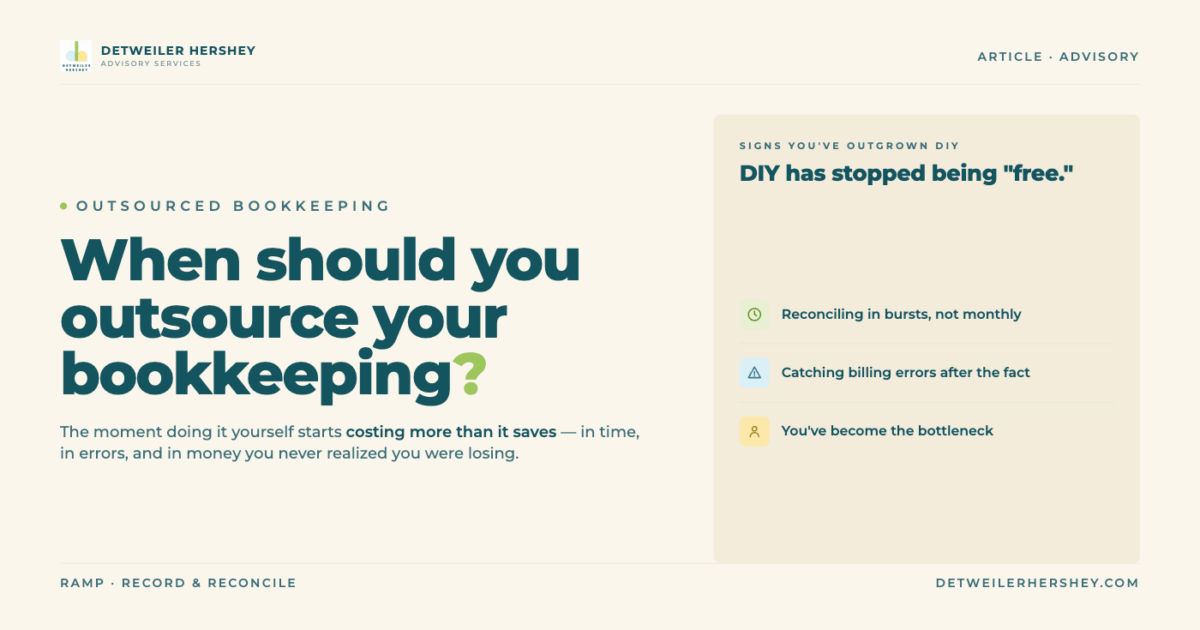
The books are consistently late, or you’re reconciling in bursts right before taxes instead of every month.
You’ve found errors after the fact: a customer invoice that never went out, a vendor charge you paid twice, a category that’s been miscoded for months.
You’ve become the bottleneck. Bookkeeping only happens when you find time for it, and that time keeps shrinking as the business grows.
When I see any one of these, I tell the owner the same thing: DIY has stopped being “free.” The cost is just showing up somewhere else now, in missed revenue and decisions made on numbers you can’t fully trust.
What does outsourced bookkeeping actually include?
Outsourced bookkeeping means a dedicated firm records and reconciles your financial activity on a set monthly schedule. That covers categorizing transactions, reconciling bank and credit card accounts, tracking what you’re owed and what you owe, and keeping the books clean enough to report from.
The part owners underestimate is the value of the schedule itself. The monthly rhythm and the second set of eyes are what catch problems, not the data entry.
How is outsourced bookkeeping different from hiring a single bookkeeper?
A solo bookkeeper records what happened. When you outsource to a firm, we record what happened and run checks against it every month.
I’ll give you a recent example. In one monthly meeting, we walked a client through several invoices they had never sent, which our reconciliation checks flagged. That same review caught items they were being double billed for. None of that would have surfaced from recording alone. It surfaced because someone was reviewing the books against a process, on a schedule.
That, to me, is the line between recording and oversight. It’s the reason outsourcing to a firm with a real monthly process protects money that a single set of hands tends to miss. If you want the full picture of how these roles stack, I laid it out in Fractional CFO vs. Controller vs. Bookkeeper.
Where does outsourced bookkeeping fit in the RAMP framework?
Bookkeeping sits at the foundation of RAMP, in the Cleanup and Foundation tiers. Cleanup handles books that have fallen behind or gotten disorganized. Foundation keeps them current and reconciled month over month.
Everything above it, reporting, controller oversight, and CFO-level forecasting, depends on this layer being accurate first. I’ve never seen good strategy come out of bad books. Clean records are the entry point to the whole progression.
What does outsourcing your bookkeeping cost you, and save you?
The cost is a predictable monthly fee instead of your own uncompensated hours. The savings show up in three places: time you get back, errors you stop absorbing, and revenue you stop leaving on the table.
For most of the owners I work with across the Indian Valley, in Souderton, Lansdale, Harleysville, Telford, and the surrounding corridor, the math tips well before they expect it to. The moment DIY bookkeeping starts hiding money is the moment it’s already too expensive. If you’re weighing the broader question of how much to hand off, I walk through it in When Should You Outsource Your Accounting?.
Frequently asked questions
How much does it cost to outsource bookkeeping? It depends on transaction volume and how far behind the books are, but it’s typically a fixed monthly fee rather than an hourly bill. We usually start with a one-time cleanup if the books need catching up, then move to a steady monthly rate to keep them current.
Is outsourced bookkeeping only for large businesses? No. In my experience small and growing businesses often benefit most, because they’re the ones where the owner is still doing the books personally and paying for it in lost time. Our Foundation tier is built specifically for businesses at this stage.
Will I lose visibility into my own numbers if I outsource? You gain visibility, not lose it. A good arrangement includes a monthly touchpoint where we review the numbers together, which is usually more insight than owners had when they were doing it alone.
How do I know if I need bookkeeping or something more, like a controller? Start with whether your books are accurate and current. If they are but you still lack oversight, monthly reporting, or a reliable close, that’s the point where a controller becomes the next step up.
What happens if my books are a mess before I outsource? That’s exactly what the Cleanup tier is for. We start by getting historical books accurate and reconciled, then transition you into a steady monthly rhythm so the mess doesn’t come back.