
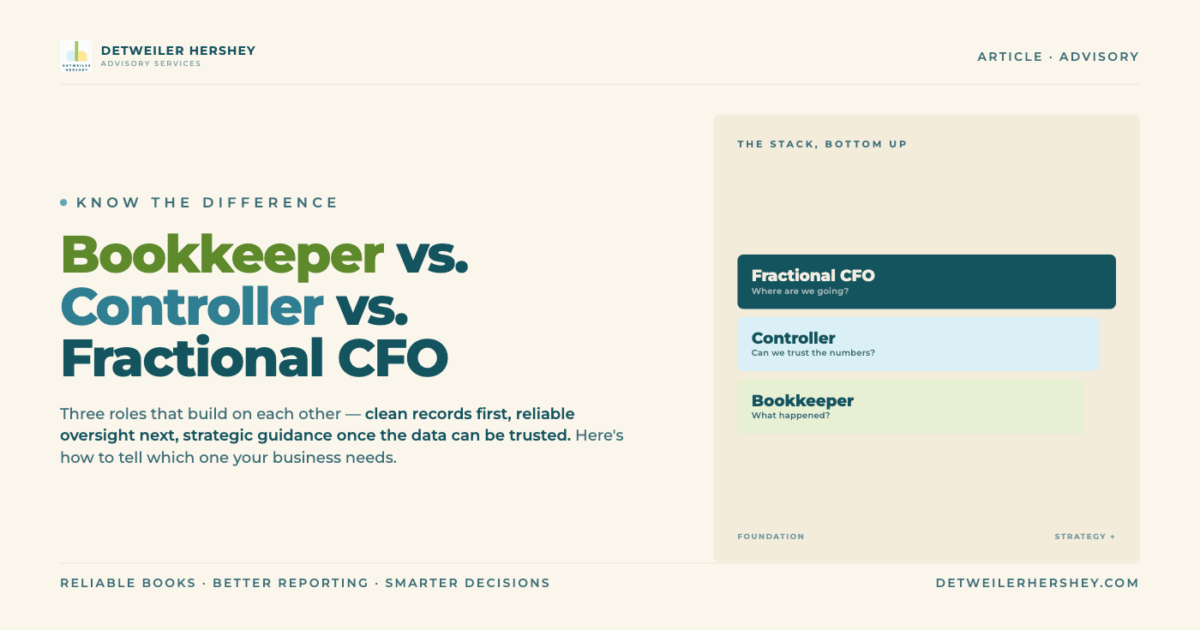
A bookkeeper records your transactions. A controller keeps your financial operation running accurately and on schedule. A fractional CFO uses that foundation to answer forward-looking strategic questions about where the business is headed. The three roles build on each other, and most growing companies need them in that order: clean records first, reliable oversight next, and strategic guidance once the data can be trusted.
Detweiler Hershey works with growth-oriented businesses across the Delaware Valley and nationally to fill these roles through its RAMP Advisory Services, scoping each engagement to where a company actually is rather than selling a level of service it does not need yet.
What does a bookkeeper do?
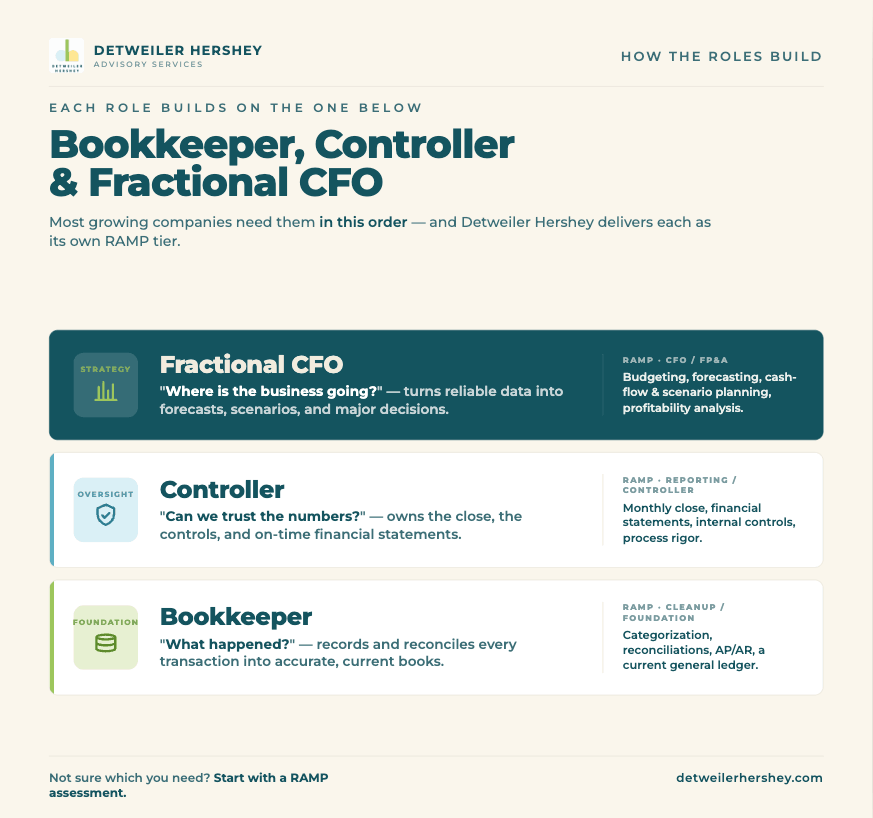
A bookkeeper records transactions. They categorize income and expenses, reconcile bank and credit card accounts, manage accounts payable and receivable, and keep the general ledger current. The output is an accurate, up-to-date record of what has already happened in the business.
Bookkeeping is the foundation everything else sits on. Without clean, current records, reporting is unreliable and any strategic analysis built on top of it sits on a weak base. A business that needs reliable monthly books is looking for bookkeeping support.
What bookkeeping does not do is interpret the numbers or tell you what to do next. It answers the question “what happened?” It does not answer “what does this mean?” or “what should we do about it?” Those questions belong to higher-level roles.
What does a controller do?
A controller keeps the financial operation running and accurate. Where a bookkeeper records individual transactions, a controller oversees the entire accounting process: closing the books each month, preparing financial statements, enforcing internal controls, and making sure the numbers are right and on time.
A controller adds rigor and structure to the finance function. They improve workflows, monitor cash flow, and create more discipline around how financial work gets done. This suits businesses that have outgrown basic bookkeeping and need someone accountable for the integrity of their reporting, but that are not yet ready for a full CFO engagement.
The controller function is about accuracy and process, not strategy. A controller makes sure you can trust your financial statements and that they arrive on a predictable schedule. They keep the engine running well. They are not primarily focused on where the business is going next, which is where the CFO role begins.
What does a fractional CFO do?
A fractional CFO provides the strategic financial functions of a full-time chief financial officer on a part-time or retainer basis. The work is forward-looking. It is about where the business is going, not just recording where it has been.
At Detweiler Hershey, fractional CFO work may include budgeting and forecasting, cash flow planning, scenario modeling, profitability analysis, and strategic support. A fractional CFO uses clean books and reliable reporting to answer the questions that actually drive decisions: Can we afford this hire? What happens to cash if growth slows for two quarters? Is this product line actually profitable once we load in overhead?
This is the role that turns accurate financial data into decisions. A fractional CFO gives you senior financial leadership (forecasting, modeling, and strategic guidance) without the salary, equity, and overhead of a full-time CFO hire. For a closer look at two of the core planning tools involved, see Budgets vs. Forecasts: Why Growing Companies Need Both.
How do the three roles work together?
The three roles form a stack, each one building on the one below it. A bookkeeper produces accurate records. A controller turns those records into reliable, well-controlled reporting. A fractional CFO uses that reporting to guide strategy and major decisions.
Because they build on each other, the order matters. A fractional CFO building forecasts on unreliable books is working on a weak foundation, which is why Detweiler Hershey often recommends getting bookkeeping and reporting in order before layering strategic support on top. Many growing businesses need the controller function before they need a CFO, which is why Detweiler Hershey separates them into distinct service tiers rather than bundling them together.
That separation is the logic behind the RAMP framework. RAMP stands for Record & Reconcile, Analyze, Measure, and Plan, and it is delivered as five tiers (Cleanup, Foundation, Reporting, Controller, and CFO/FP&A) so a business can engage at the level that fits its current situation and add support as its needs grow. You can read more in What Are RAMP Advisory Services, and How Do They Help Your Business?
In Detweiler Hershey’s experience, the businesses that get the most value are the ones that match the role to their most pressing need rather than reaching for the most senior role too early. Messy records point to bookkeeping-level support. A need for structure and reliable reporting points to a controller. A major decision that the numbers need to inform points to a fractional CFO.
Which one does my business need?
Match the role to the problem you are trying to solve right now.
You need a bookkeeper (or bookkeeping-level support) if your records are behind, disorganized, or unreliable, and your first job is simply getting clean, current books.
You need a controller if your books are reasonably clean but your reporting is inconsistent, your monthly close drags, or no one is clearly accountable for the accuracy and timing of your financial statements.
You need a fractional CFO if your books and reporting are solid but you are facing a decision the numbers need to inform: a capital raise, an acquisition, a major hire, a pricing change, or growth that has outpaced your ability to plan for it. Most businesses find fractional CFO support valuable somewhere in the $2 to $25 million revenue range, though the clearest signal is not a revenue number. It is the moment financial questions start outpacing your ability to answer them. For more on timing, see When Should You Add Fractional CFO Support to Your Business?
Many businesses need more than one of these roles over time, and often they need them in sequence as they grow. The point is to start where you are.
What this looked like for one growing company
When Genzeon, a global technology solutions provider, partnered with Detweiler Hershey, the turning point was exactly this shift up the stack. Leadership recognized that traditional, reactive accounting was not enough for a company in growth mode, so monthly financial reviews replaced retrospective bookkeeping with forward-looking strategy, and reporting that once lived in silos became a single, clear view of the business.
That is the difference between recording the past and planning for the future, and it is the practical reason these roles are worth distinguishing. You can read the full story in Achieving Financial Clarity and Scalability with Advisory Services.
To find out which role your business needs next, the starting point is a RAMP assessment with the Detweiler Hershey team. Contact us to talk through where your finance function is today and what it needs to become.
Frequently asked questions
Can one person be a bookkeeper, controller, and CFO at the same time?
In a very small business, one person sometimes covers all three functions, but the roles are distinct skill sets and they pull in different directions. Recording transactions, overseeing accounting processes, and setting financial strategy each demand different expertise. As a business grows, trying to stretch one person across all three usually means the strategic work gets neglected, because day-to-day accuracy always feels more urgent than long-range planning.
Do I need a controller before I can hire a fractional CFO?
Not always, but you do need the work a controller produces. A fractional CFO builds forecasts and analysis on top of accurate, reliable financial data. If you already have clean books and trustworthy reporting, you can add CFO support directly. If you do not, you are usually better served by getting the bookkeeping and reporting solid first, then layering strategic support on top.
Is a fractional CFO the same as an outsourced controller?
No. An outsourced controller keeps your accounting accurate and your reporting reliable on an ongoing basis. A fractional CFO uses that reporting to guide strategy, forecasting, and major decisions. They are different functions at different levels of the stack, and many companies use both, with the controller keeping the engine running and the CFO charting the route.
How much does a fractional CFO cost compared to a full-time hire?
A fractional CFO is engaged part-time or on a retainer, so you get senior financial leadership without the salary, equity, and overhead of a full-time executive. The exact cost depends on scope and how much support your business needs, which is why Detweiler Hershey scopes each engagement to your specific situation rather than charging for a level of service you do not need yet.
How do I figure out which role my business needs?
Match the role to your most pressing need. Messy or behind records point to bookkeeping. A need for structure, accuracy, and reliable reporting points to a controller. A major decision that the numbers need to inform points to a fractional CFO. A conversation with the Detweiler Hershey team can confirm the right fit and the right starting point.
2 thoughts on “Fractional CFO vs. Controller vs. Bookkeeper: What Is the Difference?”
Comments are closed.