
Outsourced bookkeeping isn’t enough once your books are clean but no one is turning them into oversight, reliable monthly closes, or reporting you can act on. In my experience that’s a controller’s job, and it’s a step up in scope, not just more hours of bookkeeping. An outsourced controller owns the accuracy, timing, and financial rhythm of your business without the cost of a full-time in-house hire. At Detweiler Hershey, I deliver outsourced controller services through the Reporting and Controller tiers of our RAMP framework, for businesses that have outgrown bookkeeping alone.
When is outsourced bookkeeping no longer enough?
You reach this point when the books are accurate and current, but you still can’t get a straight answer to a basic question on time.
The close keeps slipping, so reports arrive too late to act on. Nobody owns whether the numbers are right before they go out. You have data, but not the oversight that turns data into decisions.
The way I frame it: bookkeeping solved the recording problem. What’s missing now is a process owner. That’s the gap a controller fills. If you’re still deciding whether you’ve even outgrown DIY, start with When Should You Outsource Your Bookkeeping? and come back here once the books are handled.
What does an outsourced controller do that a bookkeeper doesn’t?
A bookkeeper records and reconciles transactions. A controller owns the integrity of the whole financial process built on top of that.
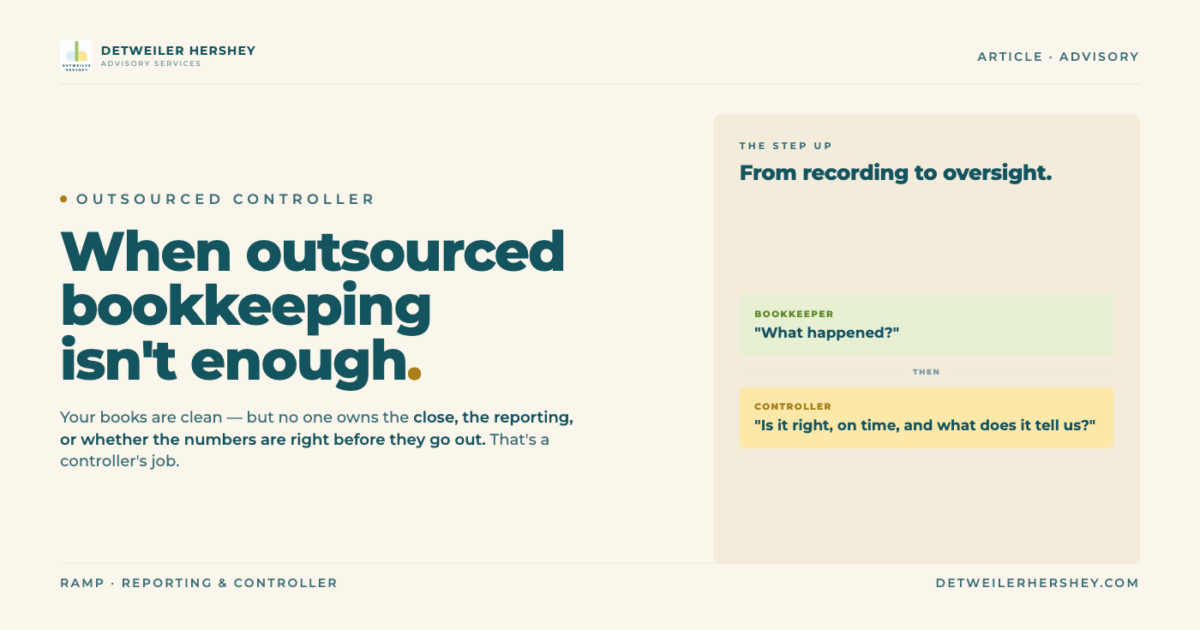
In practice that means running a consistent month-end close, making sure reconciliations are complete before reporting, producing and reviewing monthly statements, and catching issues in the numbers before they ever reach the owner’s desk. The bookkeeper answers “what happened.” The controller answers “is this right, is it on time, and what does it tell us.” Those are different jobs, and I’ve laid out the full stack in Fractional CFO vs. Controller vs. Bookkeeper.
What’s the difference between a bookkeeper and a controller?
The difference is recording versus oversight.
A bookkeeper keeps an accurate log of financial activity. A controller manages accuracy, timing, and consistency across the entire close and reporting cycle, so the business runs on a dependable monthly rhythm rather than reports that appear whenever the books happen to be ready.
One is the foundation. The other is the system of checks and discipline that makes the foundation reliable enough to steer by.
Do you need a full-time controller or an outsourced one?
Here’s what I tell most owners who think they need to hire a controller: they usually need the controller’s discipline, not a full-time salary on the payroll.
An outsourced controller gives you that oversight on a fractional basis. You get the close discipline, the reporting rhythm, and the accountability, scaled to what the business actually requires. It’s the same function, delivered without the fixed cost and hiring risk of bringing the role in-house before you can fully use it. That’s the whole point of sizing an engagement to where a business really is.
Where do outsourced controller services fit in the RAMP framework?
Controller services sit one rung above bookkeeping in RAMP, in the Reporting and Controller tiers.
Below them, the Cleanup and Foundation tiers keep the books accurate and current. Above them, the CFO and FP&A tier uses that reliable reporting to forecast and plan. The controller layer is the connective tissue: it takes clean books and turns them into a dependable, decision-ready financial process.
It’s the natural next step for a business that has outgrown bookkeeping but isn’t yet reaching for CFO-level forecasting. When it is time for that next step, I cover the timing in When Should You Add Fractional CFO Support to Your Business?.
Frequently asked questions
What’s the difference between outsourced controller services and a fractional CFO? A controller owns accuracy, the monthly close, and reporting, making sure the numbers are right and on time. A fractional CFO uses those reliable numbers to look forward: forecasting, planning, and advising on strategy. Controller is the rung below CFO in the progression, and most businesses need it first.
How do I know if my business needs a controller? The clearest sign is that your books are accurate but your reporting is late, inconsistent, or unowned. If nobody is accountable for closing the month and confirming the numbers are right before decisions get made, you need controller-level oversight.
Is an outsourced controller cheaper than hiring in-house? For most growing businesses, yes. An outsourced controller delivers the same oversight and discipline on a fractional basis, without a full-time salary, benefits, or the risk of hiring for the role before the business can fully use it.
Can Detweiler Hershey act as our controller if we already have a bookkeeper? Yes. We can layer controller oversight, close discipline, and reporting on top of existing bookkeeping, whether that bookkeeping is in-house or handled through our Foundation tier.
Where is Detweiler Hershey located and who do you serve? We’re based in Souderton, in the Indian Valley area north of Philadelphia, and we work with businesses across the surrounding corridor including Lansdale, Hatfield, Telford, Harleysville, and Quakertown, as well as remotely.