
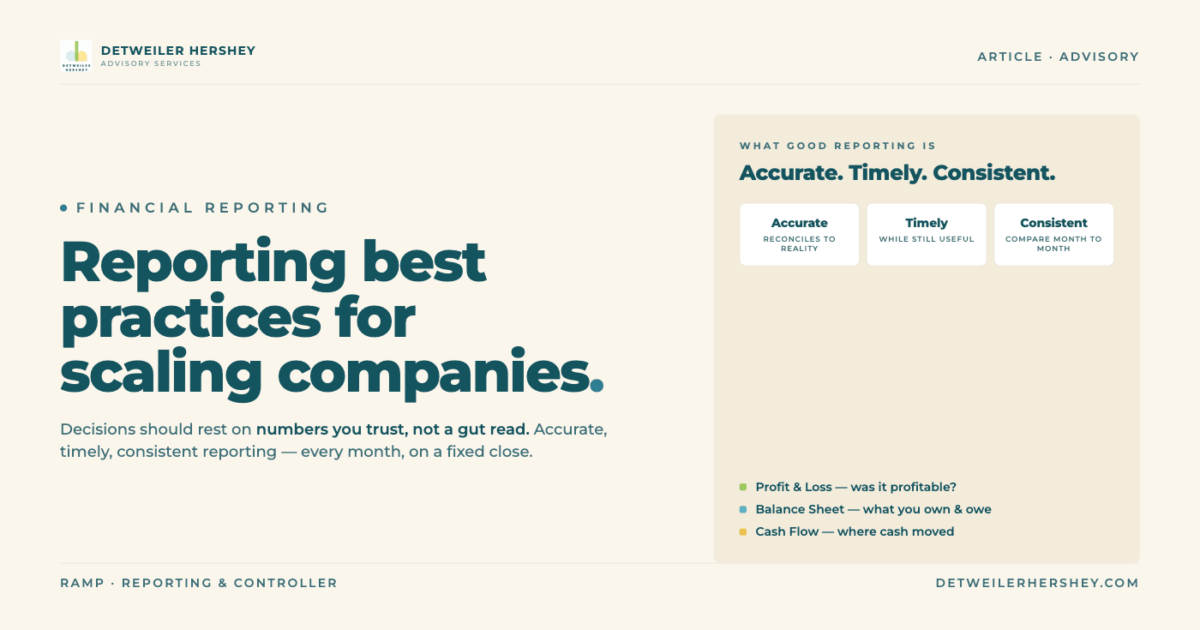
Strong financial reporting for a scaling company means producing accurate, timely, and consistent reports every month, so your decisions rest on numbers you trust instead of a gut read. The core practices are easy to name and harder to hold: close the books on a fixed schedule, standardize your chart of accounts, review the same key statements every month, and reconcile before you report. At Detweiler Hershey, I build this reporting rhythm through the Reporting and Controller tiers of our RAMP framework, where accurate books become reports an owner can actually run the business on.
What counts as good financial reporting for a growing company?
For me it comes down to three things: accuracy, timeliness, and consistency. Accuracy means the numbers reconcile to reality. Timeliness means they’re available while they’re still useful, not sixty days later. Consistency means this month’s report can be compared to last month’s without redefining the categories.
Miss any one of those and, in my experience, the reports stop being a decision tool and become a formality nobody reads.
Which financial reports should a scaling company review every month?
I tell owners to anchor on three statements: the profit and loss, the balance sheet, and the cash flow statement.
The profit and loss shows whether operations were profitable over the period. The balance sheet shows what the business owns and owes at a point in time. The cash flow statement shows where cash actually moved, which is often a very different story than profit alone.
Beyond those, I want a growing company watching a short set of trend lines: revenue by month, gross margin, and accounts receivable aging. Those show direction, not just position, and direction is what you steer by.
Why does a fixed month-end close matter?
A fixed close date is the single habit that turns reporting from an occasional scramble into a reliable rhythm. When the books close on the same schedule every month, reports arrive on time, comparisons stay clean, and problems surface while they’re still small.
Without a set close, reporting slips. And by the time the numbers are finally ready, the window to actually act on them has usually passed. I’ve watched that pattern cost owners real money.
How does standardizing your chart of accounts improve reporting?
A standardized chart of accounts means every transaction lands in a consistent, well-defined category. That consistency is what makes month-over-month comparison meaningful, and it’s what keeps a growing company’s reports from drifting as new revenue streams and costs appear.
When the chart of accounts is disciplined, the reports built on top of it are trustworthy by default. When it isn’t, every report needs interpretation before anyone can rely on it, and that’s where I see owners quietly lose confidence in their own numbers.
What role does a controller play in financial reporting?
This is where a controller earns their keep. A controller owns the accuracy and timing of the reporting process: making the close happen on schedule, confirming reconciliations are done before reports go out, and keeping the statements consistent and correct.
My view is simple. A number on a page means nothing if you can’t trust how it got there. The controller’s job is to make the process the same every month so that when you look at the report, you can just decide, instead of second-guessing the data first. For companies not ready to hire that role full time, we provide it on an outsourced basis through our controller services, so the discipline is in place without the fixed cost of an in-house hire.
Where does reporting fit in the RAMP framework?
Reporting sits above bookkeeping in RAMP, in the Reporting and Controller tiers. Bookkeeping produces accurate, reconciled books. Reporting turns those books into statements and trends an owner can act on, and controller oversight keeps that process consistent.
It’s the bridge between clean data at the bottom of the framework and the forward-looking CFO work at the top. Once reporting is dependable, the natural next question is strategy, which is where fractional CFO support comes in.
Frequently asked questions
How often should a scaling company produce financial reports? Monthly at minimum, on a fixed close schedule. In my experience quarterly reporting is too slow for a growing business, because trends and problems can develop and compound within a single quarter before anyone sees them.
What’s the difference between bookkeeping and financial reporting? Bookkeeping records and reconciles transactions. Financial reporting turns that recorded activity into statements and trends that inform decisions. You need accurate bookkeeping first, because reporting built on unreliable books just moves the errors into nicer formatting.
Do I need accounting software to report well, or is a controller enough? You need both a reliable system and the discipline to use it consistently. Software produces reports on demand, but it can’t tell you whether the underlying data is right or whether the close was done properly. That judgment is what a controller adds.
When should a growing company bring in help with reporting? When you can produce numbers but can’t consistently trust or interpret them, or when the close keeps slipping. That’s the signal that reporting has outgrown the current setup and needs dedicated oversight.
Can Detweiler Hershey handle reporting without taking over our bookkeeping? Yes, though the two work best together. Our Reporting and Controller tiers can layer oversight and reporting discipline on top of books we keep, or coordinate with an existing bookkeeping setup where that makes sense.
One thought on “Financial Reporting Best Practices for Scaling Companies”
Comments are closed.