
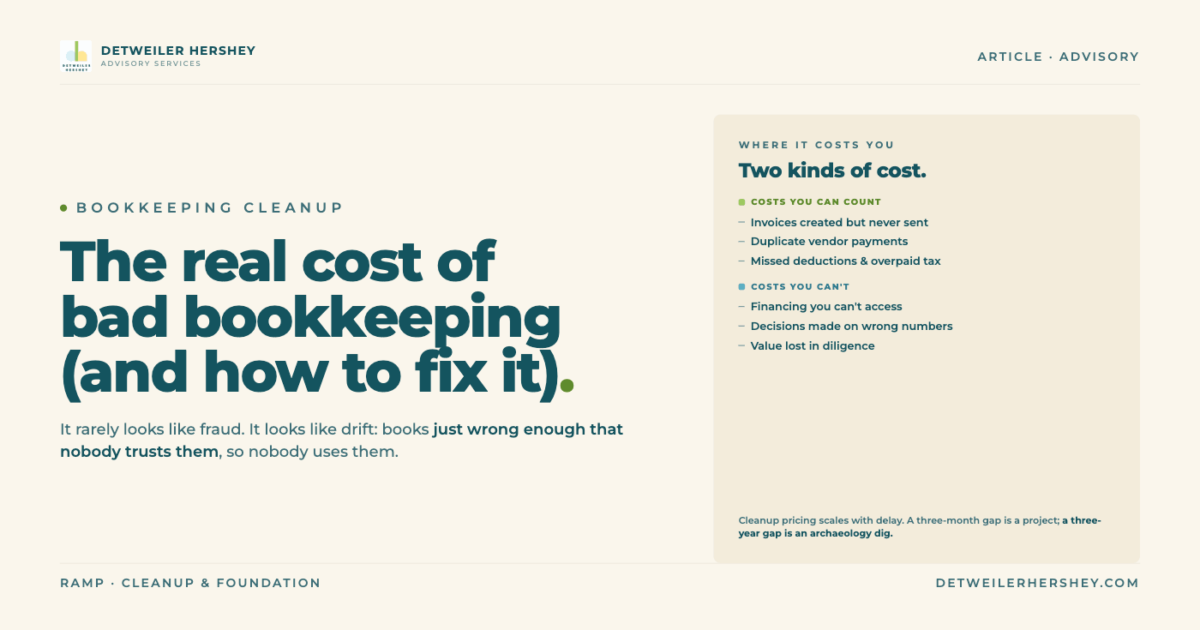
Bad bookkeeping costs a business far more than the price of fixing it. The direct losses show up as unsent invoices, duplicate vendor payments, missed deductions, and penalties. The larger losses are harder to see: financing you cannot access, decisions you make on numbers that are wrong, and a valuation that suffers when a buyer or lender finds your records unreliable. At Detweiler Hershey, we see the same pattern repeatedly in the Indian Valley and beyond. The books are not catastrophically broken. They are just wrong enough that nobody trusts them, so nobody uses them.
What does bad bookkeeping actually look like?
It rarely looks like fraud. It looks like drift.
A business starts with a simple setup, usually an owner or an office manager doing the books alongside four other jobs. Volume grows. The chart of accounts never gets updated. Reconciliations slip from monthly to quarterly to “when we have time.” Transactions get coded to whatever account looks closest. Nobody is doing anything wrong on purpose. The records simply stop reflecting the business.
Here is what I look for when I open a set of books for the first time:
Bank and credit card accounts that have not been reconciled in months. This is the single clearest signal. If the accounts do not tie to the statements, nothing downstream is reliable.
An accounts receivable aging that nobody reviews. Invoices that were never sent, invoices sent and never followed up on, and credits sitting against closed jobs.
Undeposited funds or a suspense account with a growing balance. These are where transactions go when nobody knows what to do with them.
A chart of accounts with duplicates and orphans. Two versions of the same expense account, categories nobody has used in three years, and a large “miscellaneous” bucket.
Owner draws, loans, and personal expenses mixed into operating accounts. Common, fixable, and expensive at tax time.
Payroll that does not tie to the general ledger. Usually the result of a system change that was never fully mapped.
Any one of these on its own is a maintenance issue. Three or more together means the financial statements coming out of that system are not a picture of the business.
What does bad bookkeeping cost a business?
I want to separate the costs into what you can count and what you cannot, because owners tend to underestimate the second category by an enormous margin.
The costs you can count
Revenue you never collected. This is the one that surprises owners most. In a recent monthly review with a client, the checks and balances we run every month turned up invoices that had never gone out to customers, along with items a vendor had been billing them for twice. [MICHAEL TO APPROVE: client anecdote, non-identifying] None of it required sophisticated analysis. It required someone reading the receivables and the vendor detail against a process every month. That is the difference between a bookkeeper who records transactions and a monthly process that checks them.
Duplicate and erroneous payments. When vendor records are messy, the same invoice gets entered twice under slightly different names. Without a clean vendor list and a reconciliation habit, these are close to invisible.
Missed deductions and overpaid tax. Expenses miscoded, capitalized items expensed, expensed items capitalized, and mileage or home office detail that never got captured. When the books are bad, tax preparation becomes an exercise in reconstruction, and reconstruction is conservative by nature.
Penalties and interest. Late filings, missed estimated payments, and payroll tax notices. These are avoidable, and they compound.
Cleanup fees. The longer records go uncorrected, the more expensive the correction. A three-month gap is a project. A three-year gap is an archaeology dig.
The costs you cannot count
Financing you cannot get. Lenders are not evaluating your business in the abstract. They are evaluating the numbers you hand them. If a lender has to question the statements, you have already lost leverage on rate, on terms, and sometimes on the loan itself. Clean, reconciled books do the opposite: they keep the conversation focused on your business instead of on your records.
Decisions made on the wrong information. This is the expensive one. If your gross margin is off by four points because job costs are miscoded, you will price wrong. If your cash position is overstated because deposits are double counted, you will spend money you do not have. The mistake does not announce itself. You just quietly make a worse decision and never know why the year came in soft.
Value lost at exit or diligence. When a buyer opens your books, every unexplained item becomes a question, every question becomes an adjustment, and every adjustment moves the price. Clean records do not just survive due diligence. They shorten it, which keeps a deal from stalling out.
Your own time and attention. Owners who do not trust their books end up running the business from a gut feel and a bank balance. That works at one scale and stops working at the next.
How do you fix bad bookkeeping?
Fixing it is a sequence, not a single project, and the order matters. Doing analysis on top of records you have not corrected just produces confident wrong answers.
Step one: correct the history
Start with a defined cleanup. That means reconciling every bank and credit card account back to a known-good starting point, clearing suspense and undeposited funds, correcting misclassified transactions, separating owner activity from operations, and rebuilding the chart of accounts so it reflects how the business actually runs.
This is what our RAMP Cleanup tier exists to do. It is project-based work for businesses with errors, backlogs, or disorganized records, and it usually comes into play after a bookkeeper leaves, after a system migration, or ahead of a loan, an audit, or a sale. It is deliberately a standalone engagement. You do not need to commit to advisory services to get your records corrected.
Step two: make the maintenance boring
Cleanup without a maintenance rhythm is a treadmill. You will be back here in eighteen months.
The habit that prevents recurrence is simple and unglamorous: reconcile every account every month, review the AR aging and the AP detail every month, and close the books on a schedule instead of when someone asks for numbers. We walk through that rhythm step by step in our month-end close process guide. Keeping it running is RAMP Foundation, our monthly bookkeeping tier, and it is the baseline every other tier builds on.
If you are weighing whether to keep this in house, we wrote separately about when it makes sense to outsource your bookkeeping. The short version is that the trigger is usually not cost. It is that the person doing the books has four other jobs.
Step three: start using the numbers
Once the records are clean and current, the statements become a management tool instead of a compliance artifact. That is where monthly financial reporting and, further up, outsourced controller support and CFO level work start to earn their keep. Our RAMP framework maps that progression across five tiers so there is a defined next step rather than a leap.
But I want to be direct about the order. Nobody should be buying forecasting when their bank accounts have not been reconciled since spring.
How long does a bookkeeping cleanup take?
It depends almost entirely on how far back the problems go and whether the underlying documentation still exists.
A single quarter of unreconciled activity in an otherwise sound system is typically a few weeks. A full year with a system migration in the middle, missing statements, and commingled personal activity can run a couple of months. The variable that stretches timelines most is document retrieval, not the accounting work itself.
Our first step is always an assessment, because quoting a cleanup without looking at the file is guesswork. We look at how many accounts are involved, how far back the last clean reconciliation goes, what condition the source documents are in, and whether there is a deadline driving the work, such as a loan application or a filing.
Who at Detweiler Hershey handles this work?
We are a CPA and advisory firm in Souderton, Pennsylvania, and we have been doing this work for businesses in the Indian Valley corridor and nationally since 1946. Cleanup and monthly bookkeeping sit inside the same RAMP practice as our controller and fractional CFO services, which matters more than it sounds. The people correcting your history are the people who will eventually be using it, so the chart of accounts gets rebuilt with an eye toward the reporting you will want in two years, not just the return you need to file in March.
If your books are behind, the honest first move is to get a RAMP assessment and find out how deep it goes. In my experience, it is almost always shallower than the owner fears and slightly older than they think.
Frequently asked questions
How do I know if my bookkeeping is bad or just behind? Behind means the work is correct but not current. Bad means the work that has been done cannot be relied on. The quickest test: pull your last bank reconciliation and see whether it actually cleared, then check whether your balance sheet has a suspense or undeposited funds balance that keeps growing. Being a month behind is a scheduling problem. A balance sheet that does not tie is a records problem.
Can I just fix it myself in QuickBooks? Sometimes, if the gap is short and you know what you are doing. The risk is that the most common DIY fix, forcing accounts to balance with journal entries, buries the original error instead of correcting it. That looks fine until someone with a reason to look closely opens the file. If you go this route, reconcile forward from the last verified clean period rather than plugging the difference.
Will fixing my books change my prior tax returns? It can. If a cleanup surfaces material misclassifications, unreported income, or expenses that were never captured, amended returns may be appropriate. That is a good outcome more often than owners expect, because corrections frequently run in the taxpayer’s favor. We assess that as part of the cleanup rather than treating it as a separate surprise.
How much does a bookkeeping cleanup cost? It is scoped to the condition of the records, not billed off a standard rate card, because a two-month gap and a two-year gap are not the same job. What we can say is that cleanup pricing scales with delay, so the cost of waiting another quarter is real. The assessment is where you get an actual number.
Do I need ongoing bookkeeping after a cleanup, or is the cleanup enough? The cleanup corrects the past. It does nothing to prevent recurrence. If the reason the books drifted was that no one owned them, that reason is still true the day the cleanup ends. Most businesses move from RAMP Cleanup into RAMP Foundation for exactly that reason, though some clean up specifically to close a transaction and do not need anything ongoing afterward.